Unmukts.com
The Historic: “Mother of All Deals”
By Editorial Desk, Unmukt
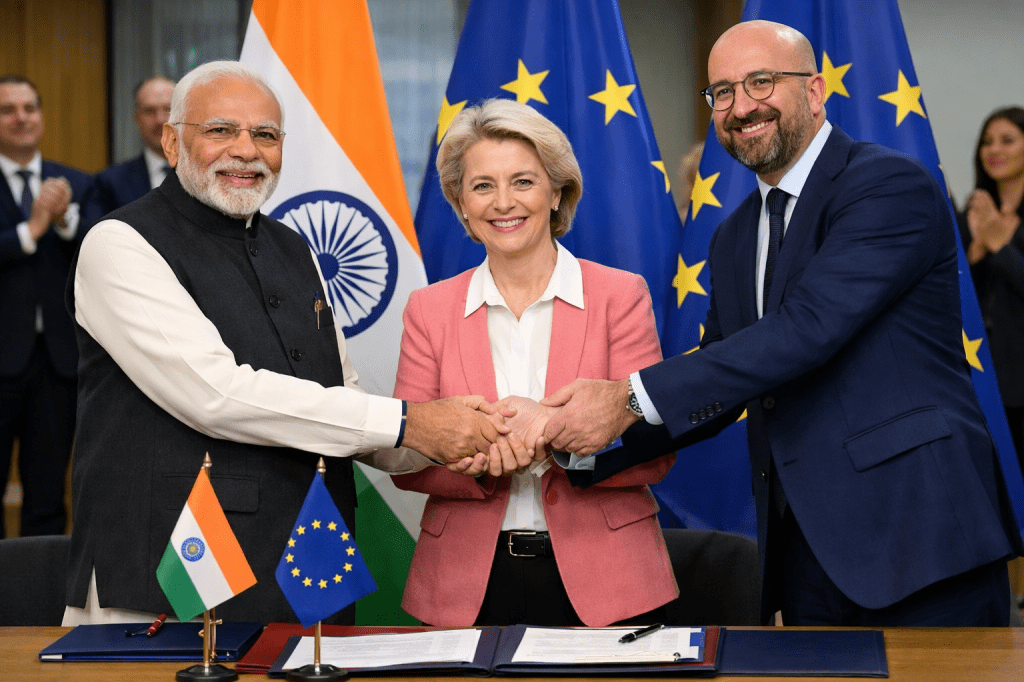
When India and the European Union announced the conclusion of their long‑awaited Free Trade Agreement in January 2026, it was quickly christened the “mother of all deals.” The phrase was not hyperbole. It reflected both the sheer economic scale of the agreement and its deeper strategic intent at a time when the global trading order is under visible strain.
This deal is not merely about tariffs, quotas, or market access. It is about re‑balancing power, rebuilding trust in rule‑based trade, and positioning India and Europe for a world that is increasingly multipolar, protectionist, and geopolitically contested.
A Deal Two Decades in the Making
Negotiations between India and the EU have spanned nearly twenty years, stalled repeatedly by disagreements over agriculture, automobiles, data, and regulatory standards. What changed now is not just political will, but strategic necessity.
Europe is seeking reliable partners as it reduces over‑dependence on China and hedges against uncertainty in trans‑Atlantic trade. India, on the other hand, is emerging as a manufacturing, services, and innovation hub that cannot remain outside major trade architectures if it wishes to scale sustainably.
The convergence of these interests explains why compromises once thought politically impossible, especially on automobiles, spirits, and services, have finally materialised.
What the Deal Really Delivers
At its core, the agreement covers almost the entire spectrum of modern trade:
- Goods: Gradual elimination or reduction of tariffs on roughly 96% of traded goods by value.
- Services: Improved access for Indian IT, business services, and professionals; clearer regulatory pathways in the EU.
- Investment: Greater certainty and facilitation mechanisms, crucial for long‑term capital flows.
- Green and Digital Cooperation: Joint frameworks on green hydrogen, clean technologies, and digital trust standards.
The much‑debated automobile provision deserves special mention. India has agreed to phased tariff reductions for European cars, while prudently protecting its domestic EV ecosystem through time‑bound exclusions and quotas. This is not capitulation; it is calibrated liberalisation.
Long‑Term Impact on the Indian Economy
For India, the agreement is a structural opportunity, not a short‑term windfall.
- Manufacturing Upgrade: Exposure to European competition will push Indian manufacturing up the value chain for better quality, stricter standards, and deeper integration into global supply chains.
- Export Expansion: Textiles, pharmaceuticals, engineering goods, gems and jewellery gain preferential access to one of the world’s richest consumer markets.
- Investment Inflows: European firms, reassured by tariff certainty and regulatory cooperation, are more likely to invest directly in Indian production rather than merely export.
- Green Transition: Collaboration on green hydrogen and clean technologies aligns perfectly with India’s long‑term energy and climate goals.
There will be adjustment pains, particularly in sensitive sectors like dairy or small‑scale manufacturing, but shielding inefficiency indefinitely is not an economic strategy. Competitiveness is.
What Europe Gains
For the EU, India represents something increasingly rare: scale combined with growth.
- A vast consumer market with rising incomes.
- A democratic, rule‑based partner at a time when values and reliability matter in trade.
- An alternative production base that reduces strategic exposure to geopolitical rivals.
European exporters, from automobiles and machinery to wines and processed foods, gain predictable access to a market that was previously one of the most protected among major economies.
More importantly, Europe gains a long‑term partner in shaping standards for the green and digital economy of the future.
The Geopolitical Subtext: The United States Factor
No serious reading of this deal is complete without acknowledging the United States.
The global trade environment is increasingly shaped by unilateral tariffs, industrial subsidies, and strategic decoupling, particularly in the United States and China relations. Even close allies of the United States have learned that economic policy in Washington can change sharply with domestic politics.
In this context, the India-EU Free Trade Agreement acts as a hedge against uncertainty. For India, it reduces dependence on any single export destination. For Europe, it supports diversification of supply chains away from geopolitical flashpoints. For the global system, it signals that large economies can still choose cooperation over confrontation.
This is not an anti-United States deal. It reflects a post-unipolar world where economic resilience is built through multiple strong partnerships rather than reliance on a single power centre.
Why This Deal Was the Need of the Hour
This agreement became inevitable due to three converging realities in the global economic landscape. First, global trade has entered a phase of fragmentation, with the paralysis of the World Trade Organization and the steady rise of protectionism making bilateral and regional arrangements unavoidable. Second, both India and Europe have come to clearly understand the risks associated with excessive concentration of supply chains in a single geography, a lesson learned through repeated disruptions and strategic shocks. Third, India today is far more confident, capable, and competitive than it was a decade ago, with stronger institutions, deeper markets, and greater manufacturing and services capacity.
Taken together, these factors show that the deal represents India’s transition from a defensive trade posture to a selectively open and strategically confident economy.
The Road Ahead: Implementation Matters More Than Headlines
The real test will lie in execution:
- Transparent rules of origin.
- Smooth customs and regulatory coordination.
- Support mechanisms for sectors facing adjustment stress.
- Continuous political commitment on both sides.
If handled well, this agreement can shape India–Europe economic relations for a generation.
More Than a Trade Deal: Mother of all Deal
The India EU mother of all deals is ultimately about choice, the choice to engage, to compete, and to cooperate in a world that is steadily drifting towards economic nationalism.
For India, it is a clear statement that the country belongs at the centre of the global economic architecture. For Europe, it represents an investment in long term stability and growth beyond its immediate neighbourhood.
History will judge this agreement not by the noise of contemporary debates, but by whether it helped create a more resilient, balanced, and genuinely multipolar global economy. On that measure, this deal begins with a strong and credible foundation.
Unmukt believes that economic confidence, not protectionist fear, is the foundation of national strength.
 unmukts.com
Leave a comment