A Chronological & Civilizational History of the Jyotirlinga on the Western Coast of India
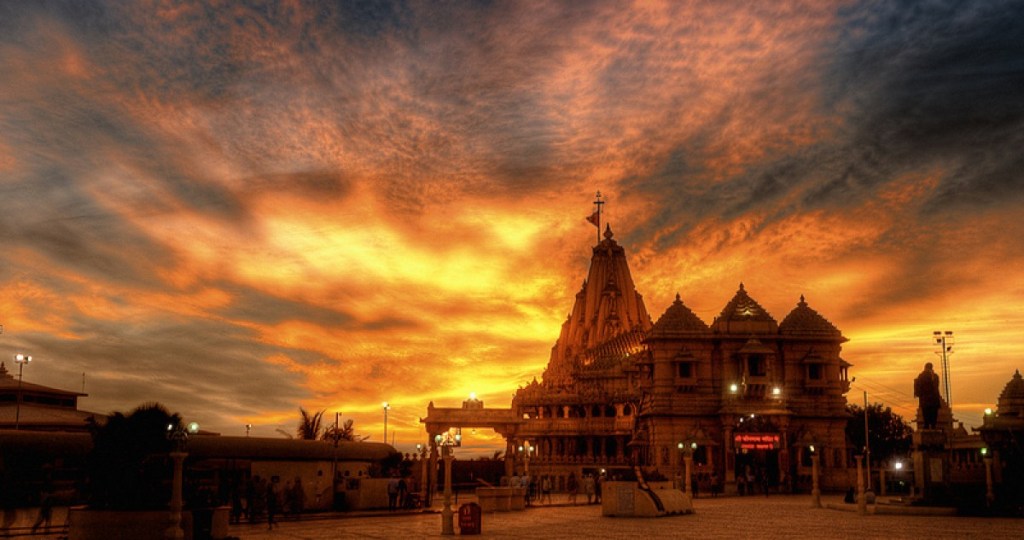
Somnath occupies a unique place in the civilisational memory of Bharat. It is not merely a temple dedicated to Shiva. It is a point where mythology, history, political power, invasion, memory, economics, faith and philosophy converge. Few monuments in the world have endured such prolonged cycles of destruction and reconstruction. Even fewer have outlasted the empires that attempted to erase them.
Somnath teaches a lesson that European historians often miss and Indian children are seldom taught. Architecture may fall when attacked, but civilisations that remember and rebuild do not disappear. Somnath has been rebuilt many times because the civilisation that revered Mahadev refused to accept erasure as fate.
Origins in Classical Tradition
The Skanda Purana, particularly the Prabhasa Khanda, describes a sequence of four primordial reconstructions of Somnath. These reconstructions span multiple epochs of Indic time.
According to this account, Somnath was built by:
- Chandra in gold
- Ravana, king of Lanka, in silver
- Shri Krishna of the Yadava lineage, in wood
- The Pandavas in stone after the Mahabharata
This sequence places Somnath across Vedic, Itihasa and Puranic periods, long before the beginnings of political dynastic history. A temple that has been built in four epochs using four different materials is not architecture. It is civilizational memory rendered visible.
The First Historical Attack in 1025 CE
The first fully documented attack on Somnath took place in 1025 CE when Mahmud of Ghazni invaded Gujarat. This is one of the most recorded temple raids in medieval history.
Persian chroniclers record that:
- Treasure from the temple was carried away using approximately one thousand camels
- The loot included gold, silver, precious gems and ritual objects
- The idol was broken and fragments were transported to Ghazni
Economic historians reconstruct the value of the loot to be:
- Roughly twenty million to thirty five million silver dirhams in period terms
- Modern valuations place this within a range of approximately four thousand crore rupees to fifteen thousand crore rupees, depending on whether one uses metal equivalence or purchasing power parity
To Mahmud, Somnath was not primarily a religious target. It was a financial target. Temples in India functioned as:
- Endowments
- Depositories for traders and guilds
- Trust banks for merchants and pilgrims
- Wealth repositories for communities
Looting Somnath was therefore an act of extracting capital. But Bharat rebuilt.
The Attack in 1299 CE
The next major record of destruction comes from 1299 CE when the generals of Alauddin Khilji, particularly Ulugh Khan and Alaf Khan, attacked Gujarat.
Chroniclers note that:
- The idol of Somnath was taken to Delhi
- The temple was looted and demolished once again
This period represents what can be described as a political economy of extraction. Wealth from temples funded military campaigns rather than ornamentation or public welfare. Rebuilding was discouraged. Yet Bharat rebuilt once again.
The Gujarat Sultanate Period, 1395 CE to 1451 CE
The third phase of destruction spans the Muzaffarid dynasty of the Gujarat Sultanate. This period involved repeated interruptions of reconstruction.
It included:
- Destruction in 1395 CE
- Further demolition and suppression of rebuilding efforts in 1451 CE
Here, the motive was not purely financial. Somnath was a symbol of sovereignty. Controlling or destroying it was a means of asserting political authority. Bharat rebuilt again.
The Mughal Period and the Attack in 1706 CE
During the reign of Aurangzeb in 1706 CE, the temple was demolished once more. The Mughal imperial system treated temples as instruments of political communication.
Temple destruction served as:
- Legitimacy building
- Religious signalling
- Imperial assertion of control
These actions are documented in Mughal records including firmans. But Somnath did not disappear from memory. Bharat rebuilt in silence and kept the site sacred through ritual and memory.
Reconstruction After Independence, 1947 to 1951
After 1947, Sardar Vallabhbhai Patel assumed direct responsibility for the reconstruction of Somnath. This was not an act of communal assertion. It was civilizational restitution.
Important milestones include:
- The decision to reconstruct in 1947 and 1948
- Construction between 1949 and 1951
- The consecration in 1951
Jawaharlal Nehru discouraged the reconstruction, considering it revivalist. Patel and K M Munshi insisted that reclaiming Somnath was essential for civilizational dignity and continuity. During the consecration, President Rajendra Prasad said:
“Somnath is the symbol of the power of reconstruction inherent in our society.”
This statement summarizes one thousand years of civilizational experience.
Civilizational Accounting
What happened to those who looted Somnath? Their fortunes demonstrate the difference between empire and civilization.
Empires of the invaders eventually:
- Dissolved
- Became dependent
- Lost legitimacy
Their descendants struggle for identity and economic survival.
Meanwhile Somnath:
- Stands
- Attracts pilgrims
- Accumulates wealth
- Deepens Dharmic memory
This contrast reveals a profound point. Looting produces short lived power. Civilizational endurance produces continuity. States pursue wealth. Civilisations pursue memory.
What Somnath Represents
Somnath is not merely a temple. It is a civilizational monument. It is older than the religions that attacked it. It predates the kingdoms that looted it. It predates colonial systems. It predates modern ideologies. If humanity survives for another five thousand years, Somnath will still be understood.
Mahadev as Devadhideva and Adi Yogi
To speak of Somnath without speaking of Shiva diminishes the subject. Shiva is Devadhideva. He is the first yogi, the first guru, the lord of dissolution and the teacher of humanity. He does not demand followers. He does not require prophets. He does not insist on conversion. He offers no heaven for obedience and threatens no hell for refusal. His wealth is not gold but awareness.
When Shiva punishes, it is not theatrical. It is cosmic. Others claim to save the world. Shiva is the world. Others call themselves messiahs. Shiva is Satya, the very truth. Others exist within time. Shiva exists beyond time.
Why Somnath Will Outlive Empires
Empires are built upon power. Civilisations are built upon memory. Somnath belongs to the latter. Those who looted it disappeared. Those who mocked it were forgotten. Those who ruled against it lost their crowns. Somnath remains, not merely as stone but as continuity.








 unmukts.com