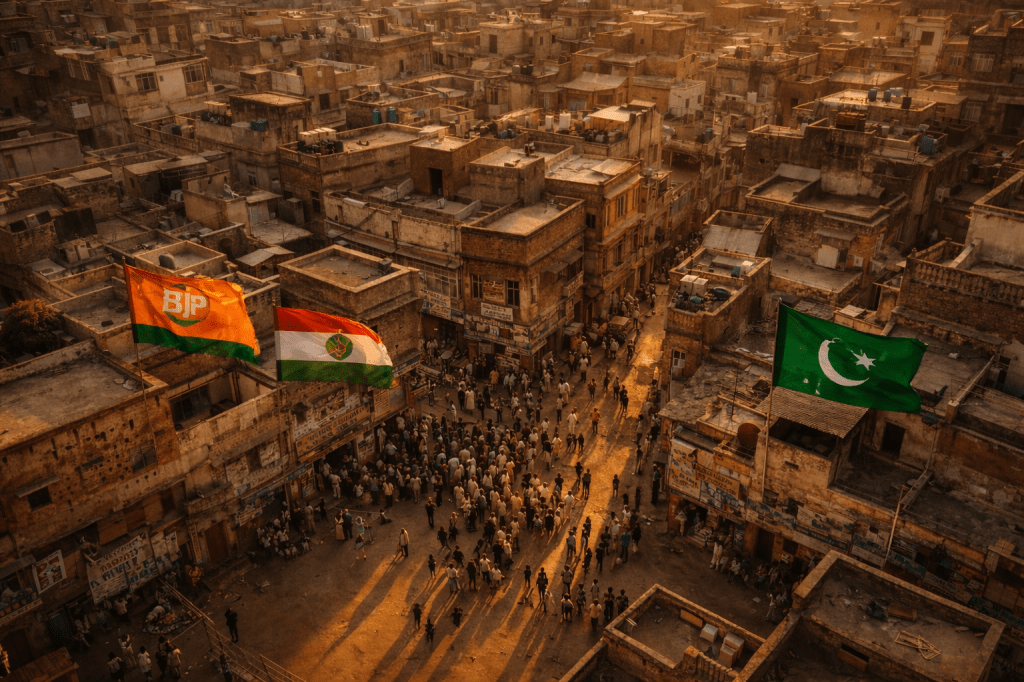
In recent years, the rise of AIMIM and similar Muslim-centric parties in Muslim-dominated constituencies has sparked debate about voting behaviour and political incentives. Most analysts attribute this to identity politics or “polarization.” However, a deeper look suggests a more structural and historical dynamic at play—one that exposes the long consequences of Congress’s asymmetric communal strategy since Independence and the contrasting political behaviour of Hindu and Muslim electorates.
I. Muslim Voting Has Historically Been Bloc-Based
In constituencies with 35–60 percent Muslim population, the voting pattern shows high consolidation behind a single party or candidate. This is not new. During the Congress era, the Muslim vote consolidated behind Congress; in the post-Mandal era, behind regional parties like SP, RJD, and TMC; and today, increasingly behind AIMIM or similar formations. The logic is simple: bloc voting maximizes bargaining power. It secured Cabinet berths under Congress, district-level patronage under SP/RJD, and now descriptive representation under AIMIM.
II. Hindu Voting Has Never Been Bloc-Based
The Hindu electorate, despite being nearly 80 percent of the population, has historically voted through the prisms of caste, region, and benefit allocation:
- Marathas with NCP/INC
- Patidars with Congress (earlier), BJP (later)
- Yadavs with SP
- Jats with RLD
- Dalits with BSP
- Lingayats with BJP (Karnataka)
- Kammas/Reddys in Andhra
- OBC splits across regions
If the Hindu electorate voted like the Muslim electorate, no smaller outfit (SP, BSP, RJD, TMC, NCP, DMK, etc.) could have ever emerged. The fact that they did emerge—and ruled—proves Hindu voting is fragmentary, not communal.
III. BJP’s Rise Is Not Primarily Hindu Consolidation but Governance-Based
The political Left insists BJP wins because of “Hindu polarization.” This claim does not stand to scrutiny. If Hindu polarization were the primary determinant, BJP would win 80 percent of seats, mirroring the religious demographic. Instead, BJP’s vote share is between 37–42 percent nationally, climbing through performance, not religious bloc voting.
BJP’s appeal is built on:
- infrastructure completion (highways, rail, power)
- welfare (housing, toilets, piped water, food)
- governance execution
- corruption control and direct benefit transfer (DBT)
- national security and foreign policy
- respect for majority cultural identity without policy concessions to clerical groups
Unlike Congress-era politics, BJP delivered tangible public goods visible to beneficiaries regardless of caste or religion.
IV. Congress Practiced Asymmetric Communal Politics
For six decades, Congress secured Muslim vote through institutional and legal concessions. Key examples include:
- Shah Bano Case (1985–1986)
When Supreme Court upheld Shah Bano’s maintenance rights, the Rajiv Gandhi government overturned the verdict through parliamentary legislation to appease conservative Muslim clergy. This signalled that secularism would be bent to secure bloc votes. - Waqf Administration and Patronage Networks
Congress governments controlled waqf boards not for reform but for political patronage, allowing clergy-politician networks to funnel benefits without structural modernization. - Uniform Civil Code Frozen for Vote Bank Considerations
Despite constitutional directive principles, UCC was shelved indefinitely to retain Muslim clerical support.
These actions incentivized bloc voting behaviour among Muslims and signalled that communal concessions would be rewarded.
V. The Rise of AIMIM Mirrors the Muslim League
As Congress weakened, Muslim-centric parties filled the vacuum, just as Muslim League capitalized on communal bargaining in the 1930s-40s. Key parallels:
- descriptive representation (our leaders for our community)
- negotiation from strength in Muslim-majority clusters
- abandonment of integrative secularism once Congress ceased to deliver
When AIMIM wins in Seemanchal, Aurangabad, or Byculla, it reflects not polarization but the rational pursuit of bargaining power.
VI. Why Muslims Left Congress and Secular Parties
The shift away from Congress/SP/TMC toward AIMIM or clergy-backed formations is not due to development; it is due to three perceptions:
- Congress no longer protects Muslim interests.
- Congress reduced Muslim representation to avoid backlash.
- Muslim demographic share in certain seats makes self-representation viable.
In essence, as soon as Congress ceased to deliver asymmetric benefits, the Muslim bloc recalibrated.
VII. The Long-Term Consequence: Fragmentation, Not Integration
India’s Muslim politics today resembles the pre-Independence communal bargaining pyramid: small clusters of concentrated Muslim populations electing Muslim-centric parties to increase negotiating leverage. This weakens integrative politics and strengthens identity segmentation.
Meanwhile, the Hindu electorate—still caste-fragmented and benefit-driven—remains structurally incapable of bloc voting unless existentially provoked. BJP’s rise comes not from religious consolidation but from governance and cultural respect without apology.
 unmukts.com
Leave a comment