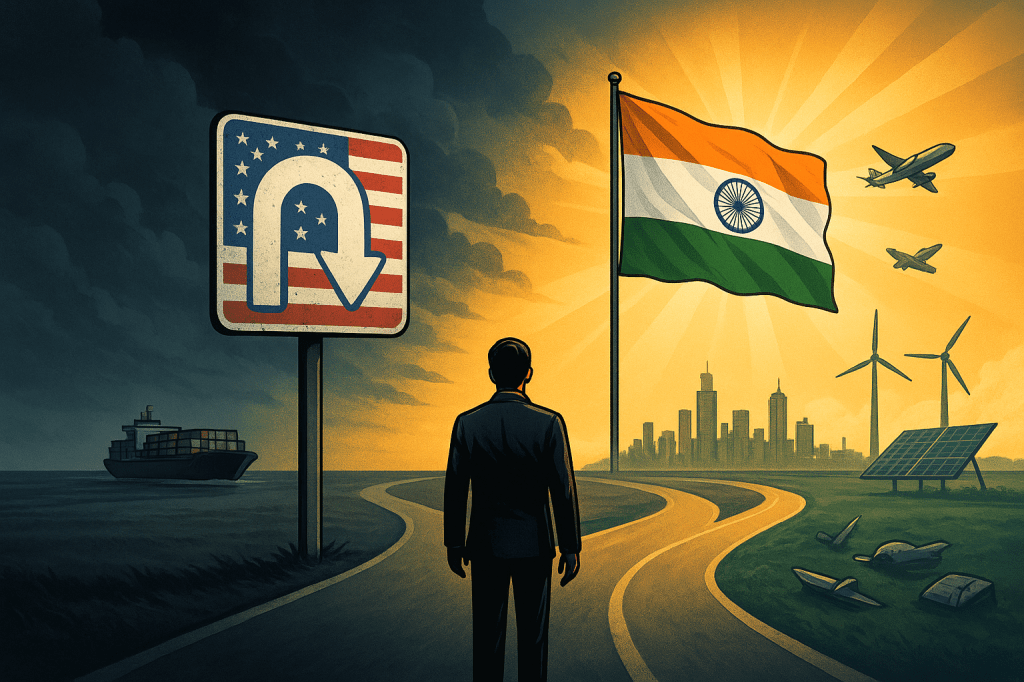
For a quarter century, Washington invested in India with remarkable consistency. From Clinton to Biden, Republican and Democratic leaders alike pursued the same long-term goal: make India a partner, a counterweight to China, and a pillar of the 21st-century global order.
That patient diplomacy, however, has now been shaken. Donald Trump’s second innings in the White House has brought an unexpected hostility toward India—undoing decades of effort. For New Delhi, the message is loud and clear: America remains a power that can never be fully relied upon.
How the U.S. Courted India
The U.S. engagement with India began in earnest with President Bill Clinton’s visit in 2000, breaking through decades of indifference. George W. Bush made the boldest leap by offering India a historic civil nuclear deal, treating New Delhi not as a rule-breaker but as a responsible global power.
The Obama administration embedded India into its “pivot to Asia,” expanded trade ties, and supported India’s bid for a permanent seat at the U.N. Security Council. Trump’s first term, despite its theatrics, elevated the Quad (with Japan and Australia) and flaunted a personal bond with Prime Minister Modi.
President Biden built on this continuity, pushing for cooperation in defense manufacturing and technology. By 2025, India had overtaken China in exporting smartphones to the U.S. — a symbolic win in global supply chains.
It appeared as if the U.S.–India relationship had become irreversible. Until Trump changed course.
Trump 2.0: A Return to Unpredictability
With little warning, Trump reversed his India policy. New Delhi was suddenly placed in the highest-risk category of U.S. partnerships, alongside pariah states like Syria and Myanmar. Meanwhile, Trump extended overtures to Pakistan, held closed-door meetings with its military brass, and dismissed India’s economy as “dead.”
The irony could not be greater. India today is the world’s fastest-growing large economy, the fourth-largest overall, and on track to overtake Germany by 2028 to claim the third spot. It is the second-largest arms importer and one of the world’s biggest consumer technology markets. For Washington to trivialize India’s rise is not just inaccurate—it is strategically reckless.
India Cannot Afford Naïveté
India has always been cautious in its foreign relations. Having been colonized, then dependent on Soviet support during the Cold War, it has long pursued a policy of strategic autonomy. Under Modi, this evolved into “multi-alignment”—building ties with Washington, Moscow, and even Beijing simultaneously.
Persistent U.S. diplomacy was slowly shifting that balance, pulling India closer to America. But Trump’s hostility has reignited old doubts. For many Indians, this is not just a policy reversal—it is proof of America’s fundamental unreliability.
The result? India is once again reminded that it must hedge its bets: maintaining ties with Russia, exploring a less confrontational approach with China, and strengthening its own independent capabilities.
The Lesson for India
Washington’s mistake may turn out to be India’s opportunity. A country that treats friends so casually cannot be the cornerstone of India’s future strategy. Instead, New Delhi must double down on self-reliance in defense, technology, and energy, while pursuing flexible partnerships across the globe.
The U.S.–India relationship will not collapse overnight. Trade, defense cooperation, and people-to-people ties remain strong. But Trump’s insults have injected caution—and perhaps a dose of realism—into India’s strategic thinking.
For decades, Indian policymakers were told that the destiny of the world’s oldest and the world’s largest democracy was to walk together. Today, India must remember: destiny is not given, it is forged. And in the turbulent 21st century, only those nations that rely on themselves will shape their future.
 unmukts.com
Leave a comment